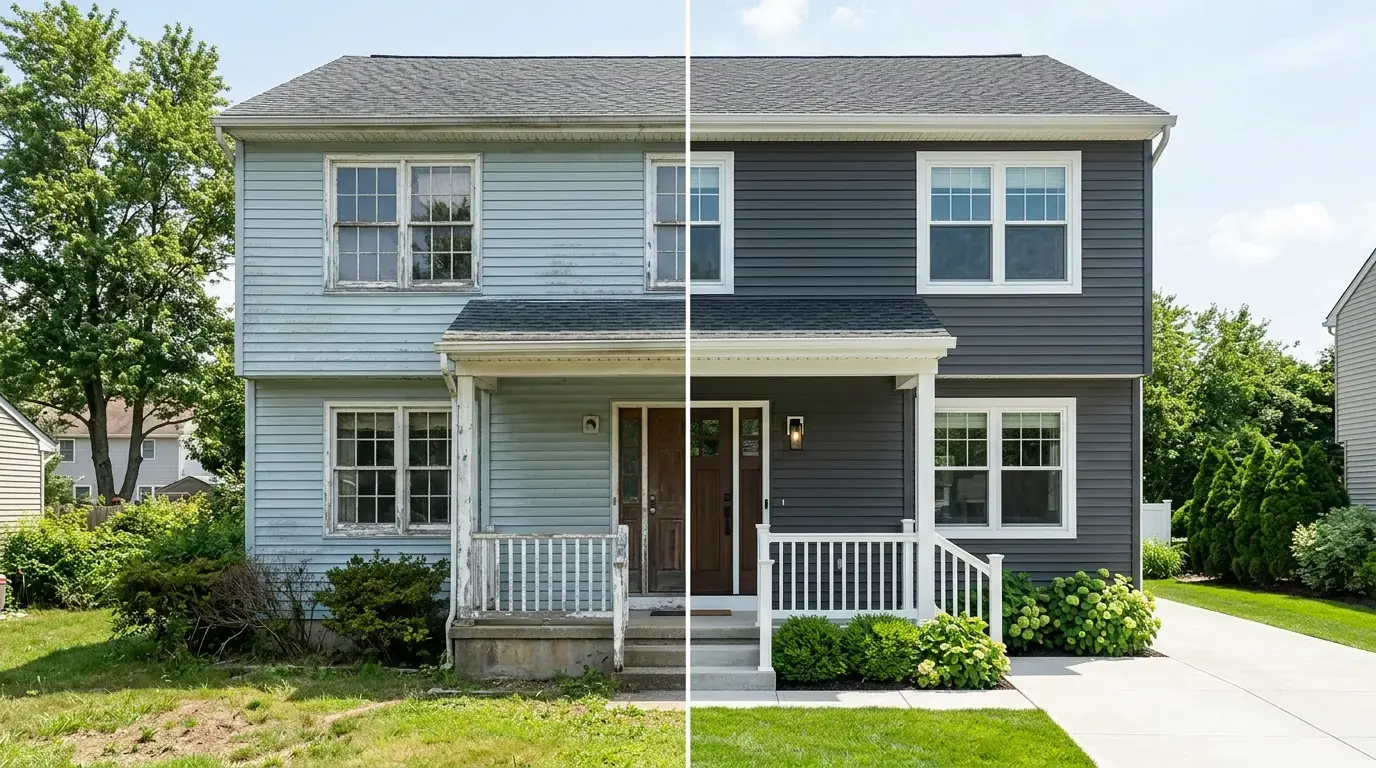
Two things show up on almost every house in this state and almost nobody knows what they are. The first is black streaking that runs down from the gutter line in long vertical drips. The second is a green or gray film on whichever wall gets the least sun. Homeowners usually assume both are dirt, try a garden hose, get nowhere, and decide the siding is permanently stained. It is not. Black streaks on siding in New Jersey and the green film beside them are two different things, and neither one is dirt in the way you are thinking about it. One is a residue problem and one is a living organism. Both come off completely with the right approach, and both come back if you only address the symptom. Understanding which is which tells you what to ask for and, more importantly, what a contractor is doing wrong if it returns two months later.
What the Black Streaks Actually Are
Those vertical drips below a gutter are usually a mix of roof runoff residue, asphalt shingle granules, road film, and organic growth all traveling the same path. Water sheets off the roof, picks up whatever is on the shingles and in the gutter, runs over the fascia, and deposits it down the wall in the same lines every storm. That is why the pattern is so consistent and why it always starts at the same points. It is not staining in the sense of dye soaking into the material. It is a deposit sitting on the surface, bonded well enough that water alone will not move it. A cleaning solution with enough dwell time breaks the bond, and the streak rinses off completely. Most homeowners are genuinely surprised by how much comes back, because they had written it off years ago.
Green, Gray, and the Shaded Side of the House
The green film is alive. It is usually algae, sometimes with mildew or moss where the surface holds more water. It grows on the elevation that stays damp longest, which in most New Jersey neighborhoods means the north side and anything under tree cover. It needs moisture and shade, which is exactly what that wall provides for most of the year. Because it is a living organism, rinsing it does almost nothing. You knock off the surface layer and leave the rest to regrow, which is why the wall looks clean for three weeks and then does not. It has to be killed with a cleaning solution given time to work. Pressure is not the answer either. High pressure on siding forces water behind the panels and can damage the surface without solving the underlying growth.
Why a Garden Hose Never Works
A hose delivers water and nothing else. Water dilutes and relocates. It does not break the bond on a deposit and it does not kill an organism. The instinct is then to rent a pressure washer and hit it harder, which is where real damage starts. Force high enough to blast growth off vinyl is high enough to drive water behind the panels, mark the surface, or on older homes blow out mortar joints and raise the grain on wood. The professional approach reverses that logic entirely. The cleaning gets done by the solution, given real dwell time on the surface, and the water only rinses at low pressure. It takes longer and it leaves a wall that is both clean and undamaged, which is not the same outcome as clean. Our power washing service uses this approach on every job.
The cleaning gets done by the solution. The water only rinses at low pressure.
How to Keep It From Coming Straight Back
Growth returns when the conditions that produced it are unchanged. If a wall is shaded, damp, and receiving roof runoff, it will grow the same things again on the same schedule. There are practical things that slow it down. Trimming back branches that keep an elevation in permanent shade helps. Cleaning gutters so runoff goes where it should instead of over the fascia helps a lot with the black streaking specifically. Beyond that, the realistic answer is a cleaning cycle rather than a permanent fix. A property washed on a regular schedule needs a much gentler treatment each time than one left for five years, which is easier on the siding and usually cheaper per visit. Waiting until it looks bad is the most expensive approach available. If washing is a first step before exterior painting or residential painting, request an estimate and we will scope both together.